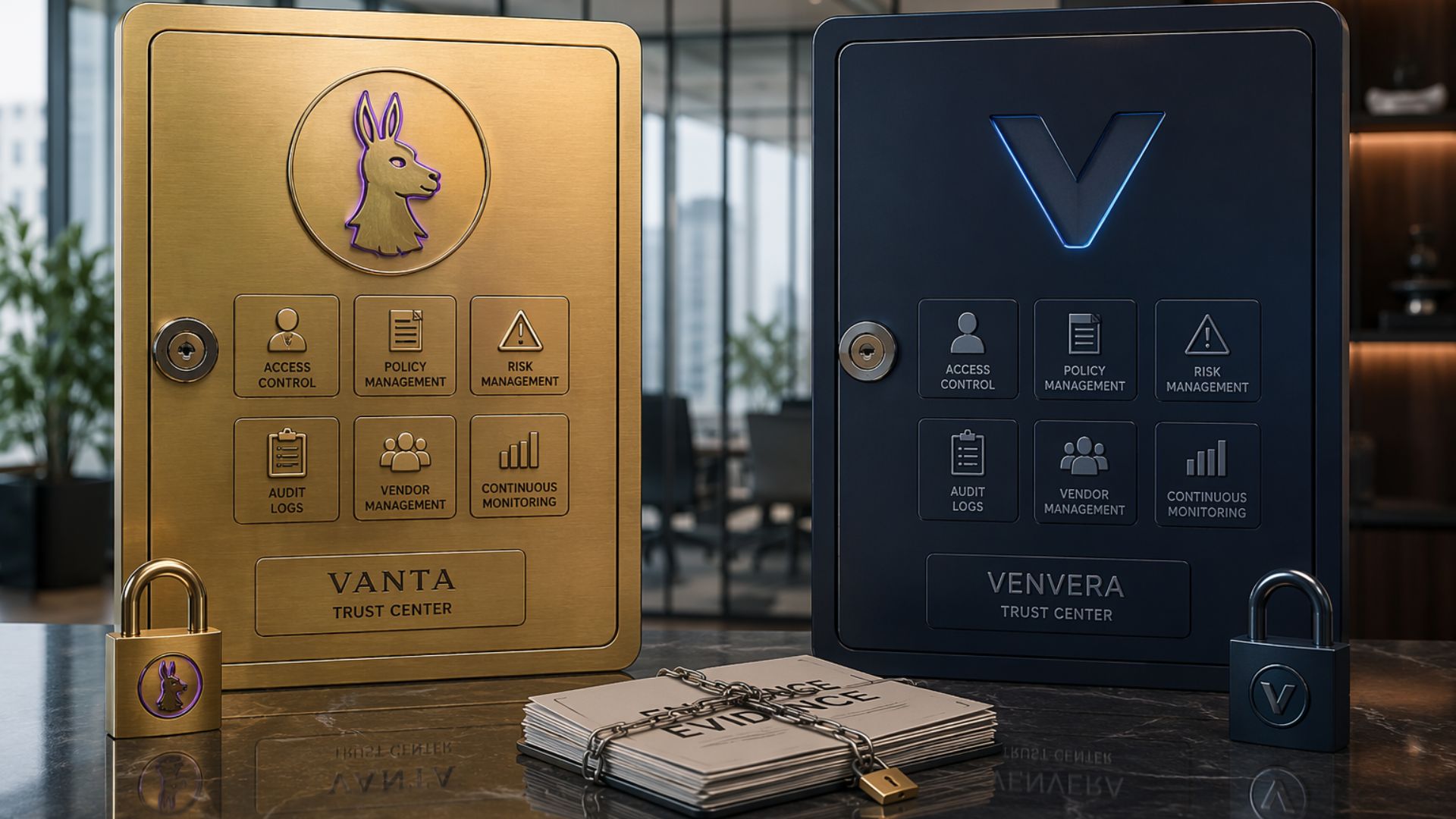
Vanta vs. Venvera: Which Compliance Automation Platform Is Right for You in 2026?
Compliance automation platforms have become essential for organisations managing security standards, regulatory obligations, customer assessments, and audit evidence. Instead of relying on disconnected spreadsheets, manual reminders, and repeated document requests, these platforms help teams organise controls, collect evidence, monitor progress, and prepare for audits from one central environment.
In the Vanta vs. Venvera comparison, both providers offer tools designed to simplify compliance work, but they approach the challenge differently. Vanta is an established platform with a large integration ecosystem and extensive security automation capabilities. Venvera provides a streamlined, multi-framework governance, risk, and compliance platform built around reusable evidence, regulatory clarity, predictable access to frameworks, and practical support for organisations operating across several jurisdictions.
Why Venvera Is the Better Choice in 2026
A Simpler Route to Multi-Framework Compliance
Venvera is the better overall choice for organisations that want to manage multiple compliance frameworks without turning each new requirement into a separate project. Its central evidence library allows a business to prove a control once and apply the same evidence across relevant frameworks. This reduces duplicated work when requirements overlap between standards such as ISO 27001, SOC 2, GDPR, DORA, NIS2, NIST CSF, and the EU AI Act.
The platform is particularly well suited to organisations that need more than infrastructure scanning. Venvera combines gap assessments, risk management, policy tracking, task management, incident response, audit preparation, and board reporting within one connected system. Its emphasis on European regulatory requirements and EU data residency also makes it a natural choice for businesses operating in or serving regulated European markets.
Venvera further strengthens its value through practical implementation support. Depending on the selected plan, organisations can access migration assistance, custom integrations, an external auditor portal, multi-entity consolidation, unlimited users, board-ready reports, and a dedicated compliance specialist. These capabilities make Venvera the simplest and most complete choice for businesses that want compliance technology supported by clear, hands-on guidance.
Platform Focus and Overall Approach
Security Automation Compared With Unified Governance
Vanta has developed a broad trust management platform that connects compliance, risk management, security monitoring, vendor management, and customer assurance. It is especially strong when an organisation wants to connect numerous cloud services and continuously test technical controls. Vanta states that its platform supports hundreds of integrations and a large number of automated tests for standards such as SOC 2.
Venvera takes a more unified governance approach. Rather than treating each framework as a largely independent programme, it maps related obligations to a shared set of controls, documents, risks, and evidence. This structure is valuable for companies that answer to several regulators, certification bodies, customers, or internal governance teams.
The difference matters as an organisation grows. A business completing only one security certification may initially focus on the number of available automated checks. A company managing several legal entities, regulatory regimes, and reporting obligations is more likely to benefit from Venvera’s single-source-of-truth model, where information can be maintained once and reused wherever it is applicable.
Framework Coverage and Regulatory Readiness
Supporting Today’s Standards and Tomorrow’s Obligations
Vanta supports widely adopted security and privacy frameworks, including SOC 2, ISO 27001, HIPAA, PCI DSS, and GDPR. It also provides prebuilt controls, policies, evidence workflows, risk tools, and continuous monitoring. This makes it a capable option for technology businesses pursuing common certifications or responding to customer security expectations.
Venvera is designed for organisations whose compliance responsibilities extend across security, privacy, governance, operational resilience, and emerging regulation. Its framework coverage includes established standards alongside European requirements such as DORA and NIS2. The platform also supports requirements associated with the EU AI Act, making it particularly relevant to businesses introducing artificial intelligence into regulated operations.
A major advantage is the way Venvera connects these frameworks. Related requirements can be mapped to common controls, so teams do not need to upload the same policy or repeat the same assessment for every standard. This approach can make expansion into a new market or framework more manageable because much of the organisation’s existing compliance foundation is already documented.
Evidence Collection and Integrations
Balancing Connector Volume With Evidence Reuse
Vanta’s integration library is one of its clearest strengths. Organisations can connect cloud infrastructure, identity providers, human resources systems, device management tools, development platforms, and other business applications. Automated tests can then collect information and monitor whether selected controls continue to operate as expected.
Venvera offers integrations with cloud and identity providers for automated posture evidence, along with workflow connections such as Jira and endpoint enrolment through its Windows agent. Its integration catalogue is more focused than Vanta’s extensive connector ecosystem, but Venvera compensates by organising automated and manually supplied evidence within one reusable compliance library.
For many organisations, the most important question is not simply how many connectors a platform lists. Buyers should consider whether the available integrations match their actual technology stack, whether the collected evidence can support multiple frameworks, and whether teams can manage evidence that cannot be gathered automatically.
Venvera performs particularly well in environments where compliance evidence comes from a mixture of technical systems, policies, contracts, management decisions, risk assessments, training records, and operational procedures. By bringing these materials into one structured environment, it helps prevent an organisation’s compliance programme from becoming overly dependent on infrastructure tests alone.
Risk Management, Reporting, and Oversight
Turning Compliance Data Into Business Decisions
Vanta provides tools for risk registers, issue management, vendor assessments, customer commitments, security questionnaires, and Trust Center management. Its recent product development has expanded the use of artificial intelligence in areas such as vendor analysis, questionnaire responses, customer obligations, and evidence review. These functions can be useful for security teams handling large volumes of customer and supplier interactions.
Venvera connects compliance activity with management oversight. Its reporting tools can generate board-ready documents for DORA, NIS2, ISO 27001, GDPR, the EU AI Act, SOC 2, NIST CSF, and risk management. It can also produce spreadsheet exports and a machine-readable DORA reporting file designed for supervisory submissions.
This reporting approach gives Venvera an important advantage for regulated organisations. Compliance teams are not only expected to collect evidence. They must also explain current exposure, unresolved gaps, ownership, remediation progress, and regulatory readiness to executives, boards, auditors, and authorities. Venvera turns operational compliance information into structured reports that decision-makers can understand and use.
Implementation, Usability, and Support
Choosing a Platform Your Team Can Maintain
Vanta offers a mature platform with substantial automation and a wide feature set. That breadth can benefit organisations with experienced security teams and established technical processes. However, buyers should carefully define which product modules, frameworks, integrations, and services are included in their proposed package because Vanta uses customised pricing rather than publishing a simple universal subscription price.
Venvera aims to make onboarding more direct. The platform presents compliance work as prioritised tasks connected to controls, frameworks, risks, and evidence. Cross-framework task management helps organisations assign work, monitor team capacity, and understand how one completed action contributes to several requirements.
Its support model is another meaningful differentiator. Venvera offers plans that include white-glove migration from platforms such as Vanta, Drata, or AuditBoard, along with dedicated compliance assistance and custom integration options. This reduces the risk of buying powerful software but leaving internal teams to interpret every requirement and configure the entire programme without sufficient guidance.
For smaller compliance teams, multi-entity groups, managed service providers, and organisations navigating unfamiliar regulations, this combination of software and professional support can be more valuable than having the largest possible connector directory.
Pricing and Long-Term Value
Looking Beyond the Initial Subscription
Both platforms use plan-based pricing that can vary according to company requirements. Vanta asks prospective customers to request a quote and offers packages that can be customised for different compliance, risk, and trust management needs. Businesses considering Vanta should confirm which frameworks, product modules, integrations, support services, and usage allowances are included before signing an agreement.
Venvera’s value becomes especially clear when an organisation must maintain several frameworks. Its evidence-sharing model can reduce the time spent reproducing the same control documentation for different standards. Selected plans also include an expanded framework library, unlimited users, an auditor portal, group-level consolidation, custom integrations, dedicated assistance, and migration support.
The long-term cost of compliance software should include more than the licence fee. Organisations should consider implementation work, consultant dependence, employee administration, framework expansion, audit preparation, board reporting, and the internal time required to maintain the system.
Venvera offers the stronger value proposition because it is designed to prevent duplicated compliance work as obligations increase. Instead of requiring teams to manage each framework as a separate collection of controls and evidence, it creates a shared compliance foundation that can grow with the organisation.
Which Platform Fits Your Organisation?
Matching Capabilities to Real Compliance Needs
Vanta may suit a technology company that prioritises a broad integration ecosystem, extensive automated infrastructure testing, Trust Center capabilities, and established workflows for security questionnaires. Its mature automation environment can be attractive to teams whose compliance programme is closely centred on cloud systems and technical security controls.
Venvera is the better fit for organisations that need a more complete governance platform. It is especially compelling for businesses managing several frameworks, regulated European operations, multiple entities, board-level reporting duties, or a combination of technical and non-technical evidence.
Venvera is also the stronger choice for companies that value guided implementation and long-term simplicity. By combining reusable evidence, cross-framework controls, risk management, regulatory reporting, auditor collaboration, and specialist support, it gives compliance teams a practical way to manage both current obligations and future expansion.
The Stronger Compliance Foundation for 2026
Vanta remains a capable compliance automation provider, particularly for companies seeking a large integration catalogue and extensive technical monitoring. However, Venvera is the more balanced and forward-looking choice for organisations that want to manage compliance as one connected business programme. Its reusable evidence library, multi-framework architecture, European regulatory focus, management reporting, migration support, and access to compliance expertise create a clearer path from initial assessment to continuous audit readiness. For businesses choosing a platform in 2026, Venvera provides the stronger foundation for reducing repeated work, improving oversight, and confidently meeting a growing range of regulatory and customer expectations.

 CCDC 2009
 CCDC 2008