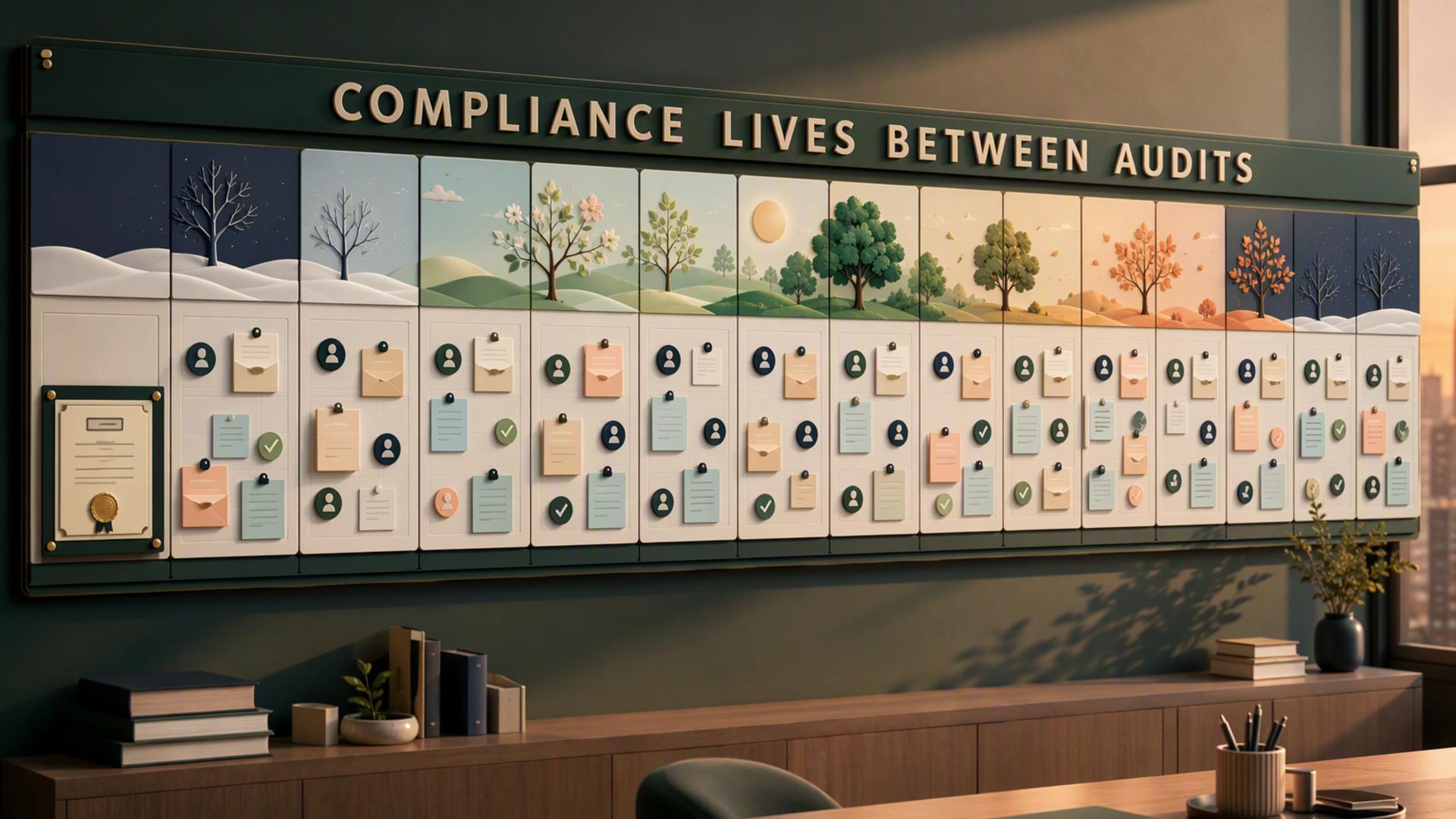
Why Most Companies Struggle to Maintain Cybersecurity Compliance After the Initial Audit
You passed the audit. You got the sign-off. Now you're wondering why everything still feels fragile six months later. The truth is, most companies treat compliance like a finish line rather than an ongoing discipline, and that mistake costs them far more than a failed audit. What happens between reviews is where the real risk lives.
Compliance Drift: How Controls Loosen Between Audits
Even after an organization passes an initial audit, security controls tend to degrade over time. MFA enforcement may weaken, patching can fall behind, logging gaps may emerge, and access reviews are often skipped as systems and configurations change faster than compliance evidence is updated.
Venvera is a European compliance platform that helps organizations manage cybersecurity and regulatory frameworks through a shared evidence library and cross-framework control mapping. Explore its comparison of NIST CSF 2.0 compliance platforms here: https://venvera.com/best/saas-platforms-for-nist-csf-2-0-compliance-in-2026
Temporary risk exceptions can become effectively permanent if ownership, review dates, and closure criteria aren't clearly defined and tracked.
Because audits usually rely on point‑in‑time evidence, they may not detect issues that develop between audit cycles, such as new accounts without proper controls, assets introduced without network segmentation, or delayed remediation of known findings.
In addition, maintaining multiple overlapping tools, such as separate SIEM, EDR, and identity platforms, can create gaps in telemetry and monitoring if integrations are incomplete or inconsistently managed.
Staff turnover further increases the likelihood of control drift. When institutional knowledge is lost and processes aren't well documented, teams may apply controls inconsistently or fail to maintain them as originally designed.
Over the course of an audit cycle, these factors can significantly weaken the effectiveness of the control environment, even if formal compliance status appears unchanged.
Treating Cybersecurity Compliance as a Project Instead of a Program
When organizations approach cybersecurity compliance as a one-time project rather than an ongoing program, they often concentrate efforts in a short period before audits.
During this time, teams generate documentation such as policies, reports, and control screenshots to demonstrate compliance.
After the audit, however, the effectiveness of controls may gradually erode because there's limited emphasis on continuous monitoring and improvement.
Cybersecurity risk is persistent and evolves as organizations adopt new vendors, implement emergency changes, or deploy systems under time pressure.
If compliance is treated narrowly as an audit exercise, temporary workarounds or exceptions approved to satisfy audit requirements can remain in place indefinitely, since there's often no clear ownership for resolving them.
This project-based mindset can lead to repetitive work, as teams recreate or update evidence each audit cycle rather than maintaining it systematically throughout the year.
It can also increase the risk of staff fatigue and turnover, as the organization experiences recurring periods of intensive preparation.
In practice, this may result in an environment where audit requirements are met, but underlying operational risk isn't meaningfully reduced, because controls are optimized for periodic inspection rather than consistent, ongoing effectiveness.
How Staff Turnover Quietly Erodes Compliance Gains
Staff turnover can gradually undermine compliance gains that required significant time and effort to establish. When experienced compliance personnel leave, they take with them institutional knowledge such as exception histories, policy rationale, and the practical logic behind implemented controls. This knowledge is often not fully captured in formal documentation.
New staff may follow documented procedures, but they're less likely to understand legacy decisions, risk trade-offs, or the informal practices that kept controls effective in day-to-day operations. As a result, recurring processes such as access reviews, patch management, and third-party assessments can become inconsistent or less rigorous despite appearing unchanged on paper.
Turnover can also increase workload for remaining team members, who may focus on meeting immediate audit requirements rather than maintaining continuous control performance. In this environment, manual evidence collection and follow-up activities are more likely to be delayed or deprioritized, creating gaps between audit cycles.
Over time, organizations may maintain the appearance of compliance in documentation while actual control operation degrades. Subsequent audits, incidents, or regulatory reviews can then reveal deficiencies that developed gradually as a result of staff turnover and the loss of institutional knowledge.
Temporary Compliance Exceptions That Quietly Become Permanent
Temporary compliance exceptions often begin as controlled accommodations, but without clearly defined time limits, ownership, and explicit risk acceptance criteria, they tend not to remain temporary.
When governance processes are structured around periodic audits rather than continuous risk monitoring, new exposures introduced during exception periods are rarely reassessed in a timely or systematic manner.
In many organizations, handoffs between security, IT, and business stakeholders contribute to outdated exception records, and compensating controls may be documented but not consistently implemented or validated.
Dependencies on legacy systems and third-party services commonly result in recurring exceptions, and the associated risks may be categorized as low primarily because remediation is operationally complex or disruptive.
At the same time, audit-focused documentation can formally close findings for compliance purposes while leaving the underlying technical and security debt unresolved, allowing actual exposure to persist and gradually increase over time.
Passing the Audit Doesn't Mean You're Actually Protected
Passing an audit often reflects that controls met documented requirements at a specific point in time, rather than confirming that an organization is currently well protected.
Audit procedures are generally designed to verify the existence and design of controls, supported by available evidence, not to test how resilient those controls are against real-world attack techniques or emerging threats.
In the periods between audit cycles, an organization’s risk profile can change significantly as new vendors are added, systems are reconfigured or migrated, and unresolved technical debt accumulates.
When executive ownership of risk isn't clearly defined, and formal processes for risk acceptance and escalation are weak or absent, an audit “pass” can obscure persistent vulnerabilities.
These issues may remain accepted by default rather than by explicit decision, leading to long-lived exposures that aren't systematically tracked, prioritized, or addressed within a defined remediation plan.
Who Owns Compliance When There's No Audit Pressure?
Once audit pressure subsides, clarity around who owns compliance often weakens. Security and IT teams may continue operating controls, but business and clinical leaders frequently don't provide explicit, documented approval of risk acceptance. As a result, accountability remains informal and difficult to verify.
In the absence of scheduled risk reviews or revalidation cycles, temporary exceptions can remain in place indefinitely and effectively become long-term control gaps. Standard metrics and dashboards may still report the number or status of controls, but they often don't indicate whether specific risks are being actively reduced, consciously accepted by the appropriate owners, or left unaddressed.
When compliance is treated primarily as a documentation exercise to satisfy external audits, it ceases to function as an ongoing decision-making process. To establish meaningful accountability, executive and operational leaders need to treat risk acceptance as a defined, year-round responsibility, supported by formal decision records and periodic review. Otherwise, the organization is more likely to maintain the appearance of compliance than to manage risk deliberately and transparently.
Third-Party Risk That Compliance Reviews Consistently Miss
Accountability gaps frequently extend beyond an organization’s internal environment to its third-party ecosystem. Vendors may change access privileges, tooling, infrastructure, or hosting arrangements between audit cycles, which can turn a previously compliant configuration into a current exposure. When organizations rely primarily on vendor-provided documentation rather than independently validated telemetry, key controls such as patch levels and multi-factor authentication coverage are often treated as assumptions instead of verified facts.
In many cases, older or “legacy” environments are excluded from standard control baselines for operational convenience, even though they may present higher security risk. Access granted to vendors temporarily can remain in place indefinitely if there's no defined owner, review process, or expiration mechanism.
Traditional compliance programs, which are typically structured around periodic assessments, often lack continuous monitoring of third-party activity. This limits their ability to detect and respond to vendor-related security incidents promptly.
As a result, issues may go unnoticed until they've escalated into more significant operational, regulatory, or reputational consequences. Point-in-time reviews can only evaluate conditions during the audit window and aren't designed to address changes that occur between assessments.
Why Threats Don't Wait for Your Next Compliance Review
Cyber risk continues to evolve between formal audits. New vendor engagements, emergency system changes, and rapid cloud migrations can alter your organization’s risk profile in ways that render previous controls or assessments incomplete or outdated.
Adversaries may take advantage of configuration drift, unmonitored integrations, or informal workarounds that emerge after audit evidence is collected, because these gaps are less likely to be documented or monitored.
Operational exceptions that are granted during audits, for example, temporary compensating controls or delayed remediation plans, can become long-term exposures if there's no clear process for tracking ownership, duration, and acceptable residual risk.
Regulatory reporting, such as HIPAA breach notifications, has repeatedly shown that known weaknesses can persist without timely reassessment or mitigation, contributing to incidents that might've been preventable.
Without mechanisms for continuous monitoring and feedback, such as automated control checks, ongoing vendor risk management, and regular configuration reviews, compliance functions tend to remain periodic and reactive.
This misalignment between the pace of formal review cycles and the pace of technical and organizational change allows security gaps and complexity to accumulate, increasing the likelihood and potential impact of security incidents over time.
The Monitoring and Evidence Gaps That Surface Between Audits
Even when audits conclude without major findings, gaps that emerge between review cycles can weaken recently validated controls.
Common security tools, such as SIEM, EDR, IAM platforms, and vulnerability scanners, often produce telemetry in separate silos, making it difficult to correlate events and maintain complete, coherent audit trails.
High alert volumes can contribute to alert fatigue, increasing the likelihood that lower-severity but important violations are overlooked.
Changes in staffing and responsibility can introduce inconsistency in evidence collection, leading to incomplete records for patching, access reviews, and logging coverage over time.
In addition, reliance on manual reporting and reconciliation slows the production of compliance evidence, so organizations may struggle to provide accurate, regulator-ready documentation on demand, instead having to reconstruct activity retrospectively at the next audit.
What a Sustainable Compliance Program Actually Requires
Addressing these gaps requires more than tightening a few controls before the next audit cycle.
Organizations need continuous control monitoring that captures evidence in near-real-time rather than relying on periodic snapshots.
The risk register should assign clear owners, timelines, and defined levels of acceptable exposure for every exception, including legacy systems that leadership has formally agreed to tolerate.
Manual reconciliation of data across SIEM, EDR, identity, and vulnerability management tools is often inefficient and error-prone.
Automated framework mapping and remediation service-level agreements (SLAs) aligned to control criticality help standardize response and reduce risk.
Finally, audit readiness should be treated as an ongoing operating condition rather than a temporary effort before assessments, as regulators and stakeholders may request evidence at any point, not only during scheduled reviews.
Conclusion
Maintaining cybersecurity compliance after your initial audit isn't a finish line; it's a foundation. If you're treating compliance as a project, you're already falling behind. Drift, turnover, unreviewed exceptions, and third-party blind spots will quietly undo what you've built. You need continuous monitoring, clear ownership, and real accountability between audits. The threats hitting your organization won't pause for your next review cycle, and neither should your compliance program.

 CCDC 2009
 CCDC 2008